Track bikes are available at Radfieber for sporty riders who value purist design. Track bikes have no gears and no brakes, which makes them particularly lightweight and low-maintenance. Track bikes are suitable both for use on the velodrome and for urban fixed-gear riders. At Radfieber you will find track bikes from renowned manufacturers: Ridley, Schindelhauer and Stevens. At Radfieber, customers receive detailed consultation on the various track bikes and can test them on site – in Cologne, Düsseldorf and Berlin. Some of the track bikes are offered at a reduced price. The reduced models are available in the external warehouse and can be delivered within a few working days.
.png) Schindelhauer HEKTOR Fixed-Gear / graphitschwarz
Schindelhauer HEKTOR Fixed-Gear / graphitschwarz.png) Schindelhauer HEKTOR Fixed-Gear / granatrot
Schindelhauer HEKTOR Fixed-Gear / granatrot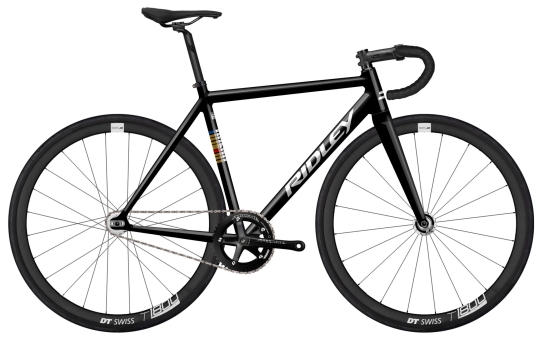 Ridley ARENA ALU Miche Pistard / Dark Denim metallic
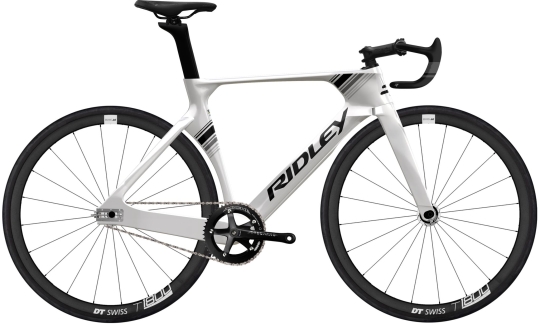 Ridley OMNIUM FAST / Pearl White / Dove Grey Glossy
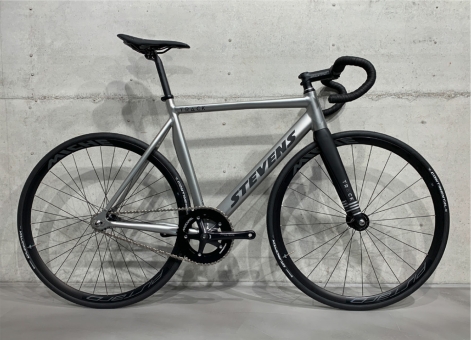 Stevens 2024 TRACK / Frozen Silver
.jpg) Schindelhauer HEKTOR Fixed-Gear / chamäleon
Schindelhauer HEKTOR Fixed-Gear / chamäleon.jpg) Schindelhauer HEKTOR Fixed-Gear / drachenfrucht
Schindelhauer HEKTOR Fixed-Gear / drachenfruchtThe origins of track cycling lie in England in the 1870s, when, after the Industrial Revolution, the first bicycle races took place on purpose-built tracks. These early velodromes consisted of two straights and slightly banked turns and were mostly made of wood or cement. Cities such as Birmingham, Manchester, Liverpool and London developed into the first centers of track cycling. The races attracted up to 2,000 spectators at the time, as the tracks allowed controlled entry. In 1877, the Brighton Velodrome, the oldest surviving velodrome in the world, was opened.
The first specialized track bikes emerged parallel to the development of the safety bicycle in the 1880s. In contrast to the penny-farthings of the time, they had two equal-sized wheels, a chain drive, and a fixed gear without freewheel or brakes. John Kemp Starley's Rover Safety Bicycle of 1885 served as the foundation for the first dedicated track bikes. These early track bikes were made of steel and featured a simple but sturdy frame that withstood the high forces on the track. In 1893, the first Track Cycling World Championships took place in Chicago, where athletes from around the world competed on these specialized machines.
In the 20th century, track bikes underwent continuous technical development. In the 1930s, lighter steel alloys were introduced and frame geometry was aerodynamically optimized. From the 1970s onward, aluminum and later carbon fiber found their way into track bike construction, leading to a drastic reduction in weight. The introduction of aerodynamic components such as disc wheels and aero handlebars significantly increased speed on the track. Today, modern carbon track bikes often weigh less than seven kilograms and are the result of decades of optimization.
Track cycling is now a firm fixture in international top-level sport and has been continuously Olympic since 1896, with the exception of 1912. The UCI organizes annual Track Cycling World Championships, where athletes compete in disciplines such as Sprint, Keirin, Omnium and Team Pursuit. State-of-the art velodromes such as the Lee Valley VeloPark in London or the OderSpree-Tenne in Frankfurt an der Oder offer perfect conditions for record attempts. Nations such as Great Britain, Germany, Australia and the Netherlands dominate the international track cycling scene. Track cycling combines the highest technical precision with athletic peak performance and captivates millions of spectators worldwide.


