At Radfieber you will find Stevens children's bikes - real mountain bikes for the "little ones". Stop by in Cologne, Düsseldorf or Berlin and discover the colorful world of children's and youth bikes at Radfieber. With a test ride or without - feel free to contact us with any questions! And isn't there also a children's mountain bike on sale?
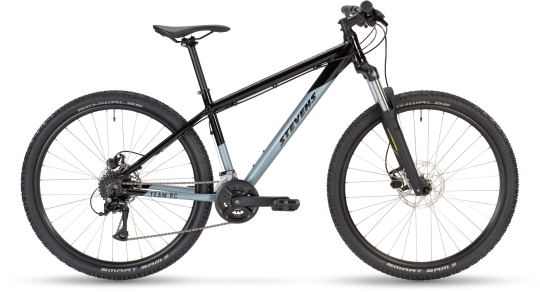 Stevens 2024 TEAM RC 27.5" Gen.2 / Space Black
 Stevens 2024 TEAM RC 27.5" Gen.2 / Lemon Lavender
The history of children's bicycles begins in 1817, when Karl von Drais presented his running machine in Mannheim – the very first two-wheeler. Even in Drais' time, there were smaller children's running machines, called celerettes. The first children's tricycles appeared in 1860, equipped with pedals on the front wheel. With the spread of the safety bicycle in the 1880s, serial production of children's bikes began in Germany as scaled-down copies of adult models. In 1887, the Munich Velociped Factory Julius Lang offered so-called "boys' velocipedes," and in 1904 Peugeot released the "Peugeot Enfant," a children's bicycle with a wooden frame. In the 1920s, children's bikes were first marketed in the United States as an independent product category by mail-order companies such as Sears Roebuck, after the automobile had increasingly displaced adult bicycles.
Modern children's bikes differ fundamentally from early models. They are made of lightweight materials such as aluminum, feature multiple gears, coaster and hand brakes, as well as child-friendly shifting systems. A milestone was the revival of the balance bike in the 1980s: the first modern balance bikes came onto the market around 1985, further developed by product designer Rolf Mertens in 1997. Balance bikes allow children from about two years of age to learn balancing playfully before switching to a pedal bike with 12, 16, 20, or 24-inch wheels. Manufacturers such as Puky, Woom, Cube, and Early Rider specialize in high-quality children's bikes that impress with low weight, ergonomic design, and adapted gearing.
Traffic education for children on bicycles is highly valued in Germany. As early as elementary school, children complete a cycling proficiency test in which they must demonstrate theoretical knowledge and practical riding skills in road traffic. The German Road Safety Council (Verkehrswacht) and the police conduct regular training sessions that teach safe behavior in traffic, proper turning, and the meaning of traffic signs. The correct equipment of the bicycle also plays a role: lights, reflectors, a bell, and roadworthy condition are mandatory. For safe riding in traffic, a well-fitting bicycle helmet and bright, reflective clothing are also essential.
In addition to classic children's bikes, there are now special models for various areas of use. Children's mountain bikes with suspension, wide tires, and sturdy frames enable first off-road experiences on gravel and forest trails. BMX bikes promote agility and balance on the pump track or in the skatepark. For sporty children, there are lightweight children's road bikes and gravel bikes that allow family tours. E-bikes for young people aged 14 and older are also available, offering as pedelecs with 250-watt motor assistance a safe and controlled introduction to the world of electric mobility. This specialization ensures that every child can find the right bike regardless of their interests.


