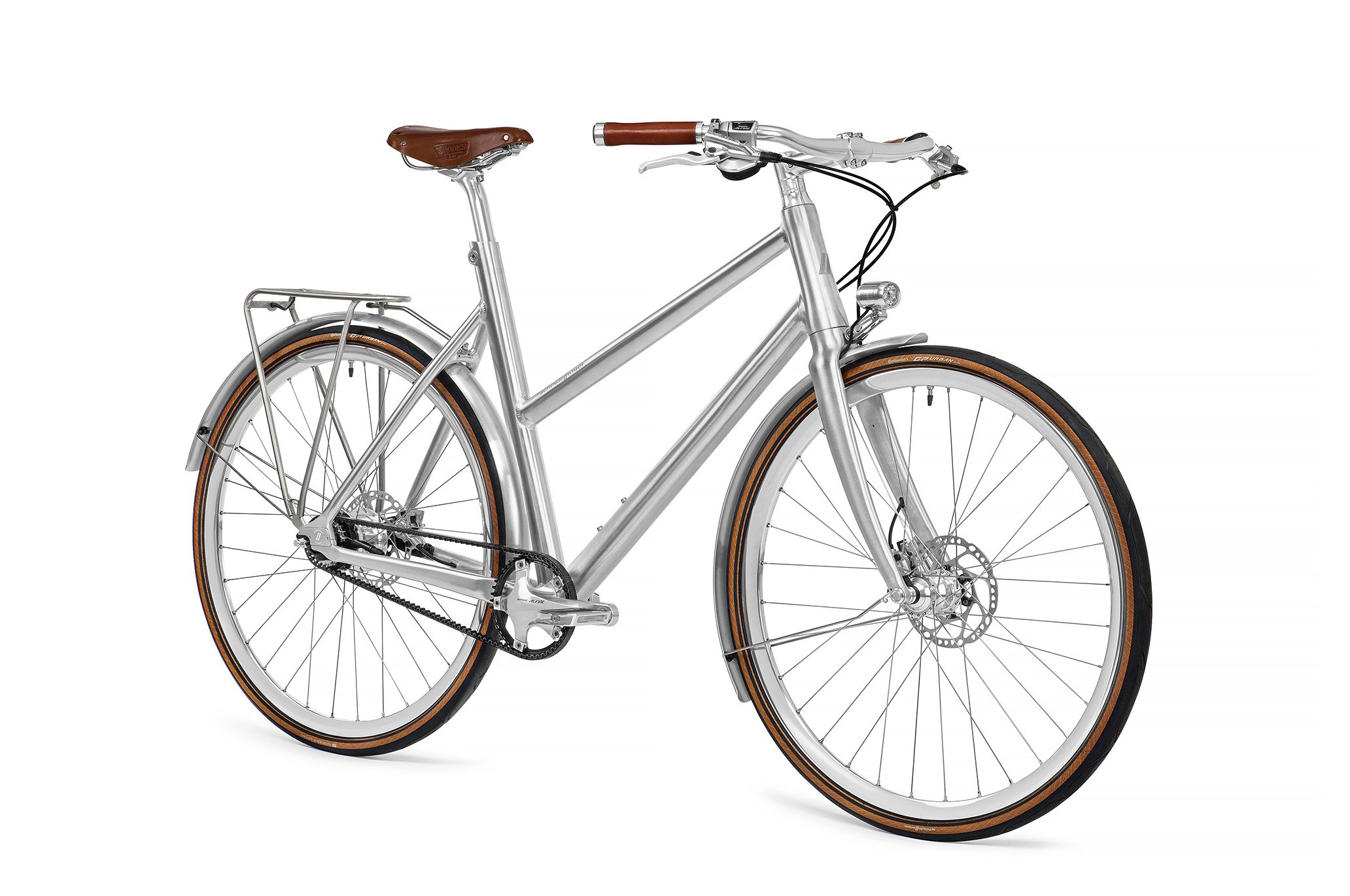
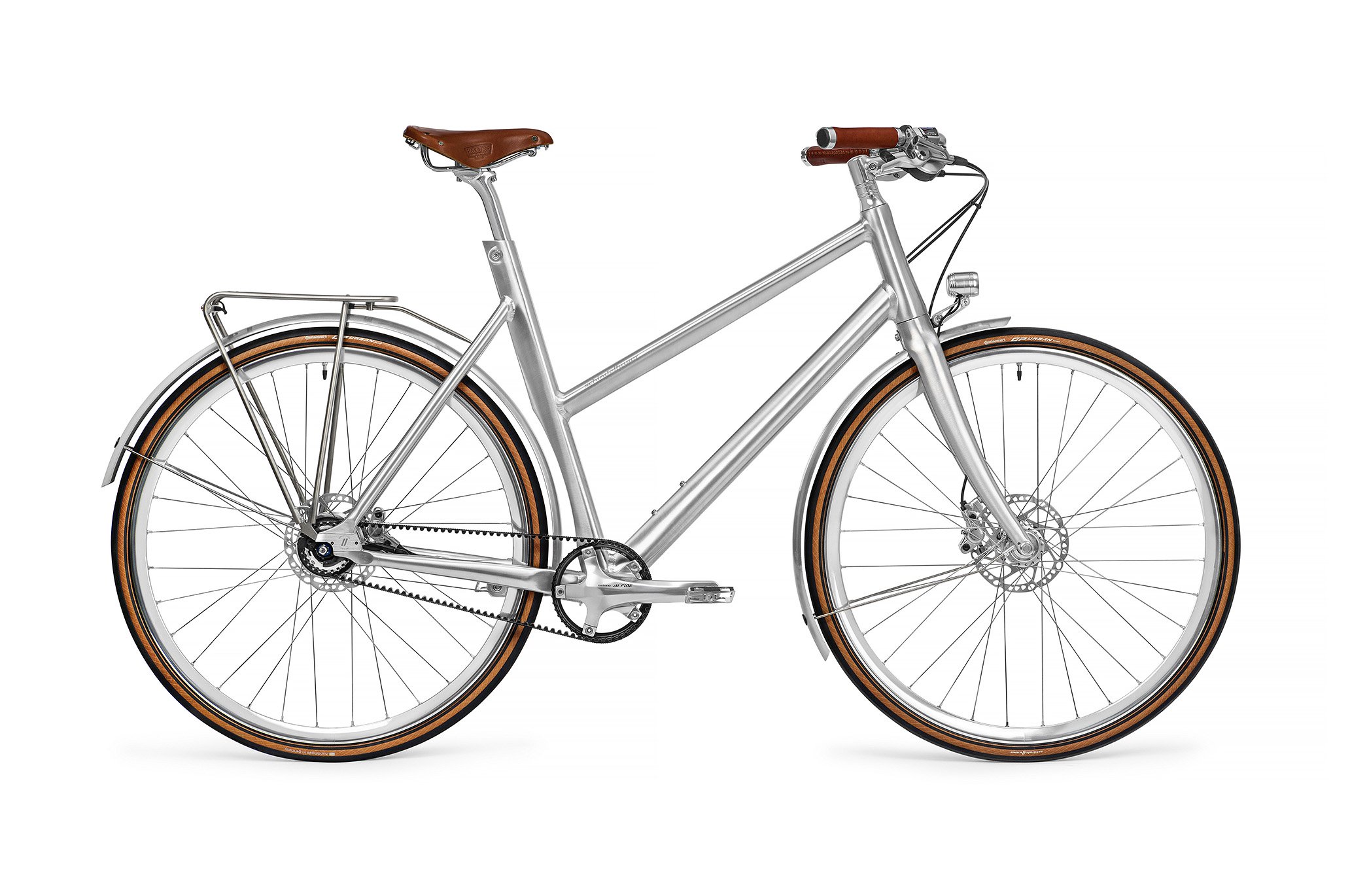

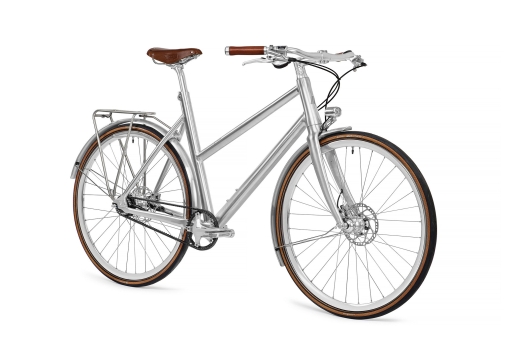
Frieda in pure aluminium – pure elegance. As a classic urban everyday bike, this model sets new standards. Thanks to the Shimano Alfine 8-speed hub gear, it is agile, efficient and stylish, and also the perfect bike for a weekend getaway. With a lightweight aluminium frame, low-maintenance carbon belt drive, Curana mudguards, integrated Supernova lights and a sleek Tubus luggage rack, it is fully equipped for the job.
Schindelhauer is a small Berlin-based manufacturer and in high demand. Bikes available online are usually only in stock once. That’s why we’d advise you to snap one up quickly. If a particular bike isn’t in stock, just ask us when it will be available again.
Some bicycles are painted in order to appeal. This one does without that. The FRIEDA VIII in Alu pure shows the material it is made of: aluminium from the AL6061-T6 alloy, its surface neither pigmented nor concealed. The triple-butted Aero-Shape tube set follows the same logic – reinforcement where torsion and longitudinal forces occur as you pedal, material removed where the frame sits in the bicycle's shadow anyway. Forged dropouts, an integrated seatpost clamp, completely internal cable routing and smoothed welds complete a construction designed for durability and backed by a five-year guarantee.
Eight gears of the Shimano Alfine 8-speed hub gear divide the range between 46 teeth at the front and 24 at the rear so that a noticeably longer stretch lies between two shifting actions. In the city that amounts to something special: you rarely shift, you ride. The freewheel works entirely inside the rear wheel, shifting happens at the grip, and every setting also holds on long lights. A path of more than a quarter turn per shift – and above all no chain that could come off, get dirty or wear through on the way.
The Gates Carbon Drive CDX delivers exactly this promise, transmitting power via a 115-tooth belt in CenterTrack geometry. Carbon fibres embedded in plastic work more efficiently than steel, resist wear a multiple of times longer and weigh about a fifth less. The frame not only stays clean but also stays just as bright: because no oil circulates, no film builds up on the bare aluminium over the years. For the Alu pure finish this is not a side aspect but the foundation of its entire character – the manufacturer commits to a material you can inspect at any time.
Belt tension is regulated by a sliding mechanism directly at the forged dropout, for which a dedicated belt port is provided in the frame. With a short pull the belt sits correctly again, without a wheel having to be removed or a tool applied – a small matter that in everyday terms means you never stand in front of a frayed belt.
Light comes from the Shutter Precision PD-8X hub dynamo in the front wheel, coupled to a Supernova Pure3, and a Supernova E3 handles the rear. Both lamps sit integrated in the rims and draw their energy from the rolling wheel. Visibility therefore depends on speed rather than on a mains socket, and the light output stays constant even if the bicycle stood in a cellar for three weeks. Combined with belt and hub gearing, this produces a bicycle in which three things that would otherwise demand attention individually – drivetrain, light and shifting – function without any intervention from you.
For trips beyond the city, the FRIEDA VIII is well prepared: the custom Tubus Fly carrier carries bags, Curana D-Light mudguards keep off the rain, and the 35-622 Continental GP Urban tyres roll comfortably over cobbles and asphalt without turning sluggish in corners. The slightly elongated wheelbase gives the kickstand firm footing and keeps space between heel and panniers. A mount for a bottle cage or lock is provided and the kickstand can be added. Mechanical disc brakes with a 160 mm diameter deliver reliable deceleration, joined by the Brooks B17 S Lady saddle, Schindelhauer Ergo leather grips, the Schindelhauer Jane aluminium handlebar and a curved aluminium fork with 15 mm thru-axle. The total weight of 13,2 kg remains light enough despite this equipment to move the bicycle yourself through cellar stairs and doorways.
The first part of the model name is a proper name that the Berlin manufacturer gave its comfort-oriented city bicycle and itself explains with the subtitle “the comfortable one”. No official account of where the first name originates is given – and that is deliberate, because the name is not a technical abbreviation but describes an attitude: upright rather than sporting, clear rather than tucked down, calm rather than hectic. It emerged as the feminine half of a deliberately chosen pair of models whose male counterpart carries the same technical foundation.
The Roman numeral is the technical brief: VIII stands for eight gears of the Alfine hub gear. This convention applies across the family, with the eleven-gear version correspondingly carrying the XI. The name therefore bundles riding character and gear level into one. The third element, Alu pure, describes the surface: a coating in a very light, warm sand tone that is close to the bare material without concealing it. A name that condenses attitude, technology and colour into three components.
Within the Frieda family the VIII differs from the XI in one single respect: the width of the gearing. Frame, drive and equipment are identical – the same AL6061-T6 structure, the same Gates Carbon Drive CDX with 115-tooth belt, the same combination of Shutter Precision hub dynamo and Supernova lamps, the same Tubus Fly carrier, the same Curana mudguards, the same saddle, the same mechanical disc brakes with 160 mm. Eight gears stand against eleven, and with them a finer division of the same ratio between 46 and 24 teeth.
Whether the additional steps are needed depends on how far and how high the routes lead. On flat urban terrain eight gears are entirely sufficient, and the advantage is a calmer riding feel with very large power reserves per shift. As soon as a gradient with luggage, a longer Sunday route into the surrounding countryside or a stretch against a headwind comes along, eight steps are no longer enough – the bicycle oscillates between two adjacent gears and loses momentum in the process. The XI is the choice with more reserve for such cases. Anyone who knows, conversely, that daily routes stay short and gradients moderate has before them the more uncomplicated and in a sense more economical solution in the VIII.
The Limited Edition versions of the XI, pearl blue and petrol, share this technical configuration completely and differ only as colour ideas limited to 150 individually numbered examples each. They cannot be distinguished from the technology described here, since they too use belt, hub, dynamo lighting and the same frame construction.
This FRIEDA VIII is built for everyday movement through the city: the way to work, the shopping route, the appointment in the afternoon and the excursion into the countryside at the weekend. Frame, belt, hub, mudguards and dynamo light work to the same beat – reliably in rain and dust, without months of maintenance effort, and light enough not to become a burden even when carried and stored. Radfieber therefore classifies it consistently in the Urban category, in diamond frame form and with frame sizes from 50 to 58 centimetres.
Within the manufacturer's portfolio the Frieda family occupies a clearly circumscribed technical position: belt drive and conventional hub gearing, placed at its foundation instead of a derailleur or a gear hub on the bottom bracket. Other series from the same house serve different expectations – city bikes with a gear hub, sportier track and singlespeed concepts, electrically assisted models with mid-drive. The Frieda family is the interpretation that places comfort, an upright seating position and quiet running above sporting performance.
A male counterpart exists as well: the matching Friedrich carries the second name from the same pair and presents the same idea in a men's version. A comparison therefore does not pit different concepts against each other, but two manifestations of the same idea – supplemented by the choice between eight and eleven gears. In Alu pure the material itself comes to the fore: the bare frame takes up light, dust and urban grey, and thus makes visible how it is treated in daily use. That openness is the deliberate counterpart to a colour that defends itself – and the reason this bicycle loses nothing over the years.
.jpg) Schindelhauer ARTHUR X35 / graphitschwarz
Schindelhauer ARTHUR X35 / graphitschwarz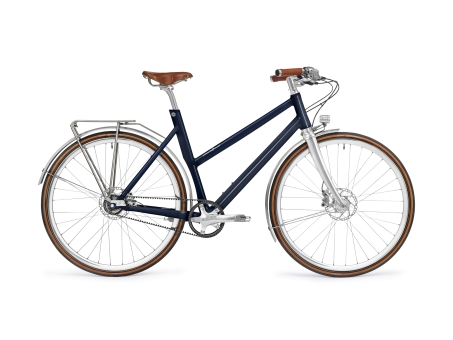 Schindelhauer FRIEDA VIII / mitternachtsblau
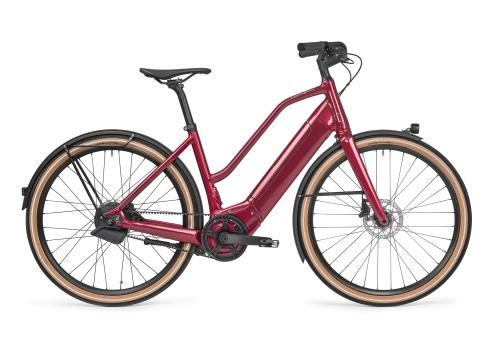 Schindelhauer HANNAH ENVIOLO


.png)
.png)